Retail as a data business enabler: Amazon Ads as an arbitrage business case.

Thanks to its massive scale and advanced technology, Amazon has successfully used its retail business to pivot to a data business, which today represents its main source of profits. Can this pivot also work at a smaller scale? Does it make any sense to execute retail only to create transactional data?

🎯 The Ultimate Arbitrage: Turning Retail Data into Advertising Gold

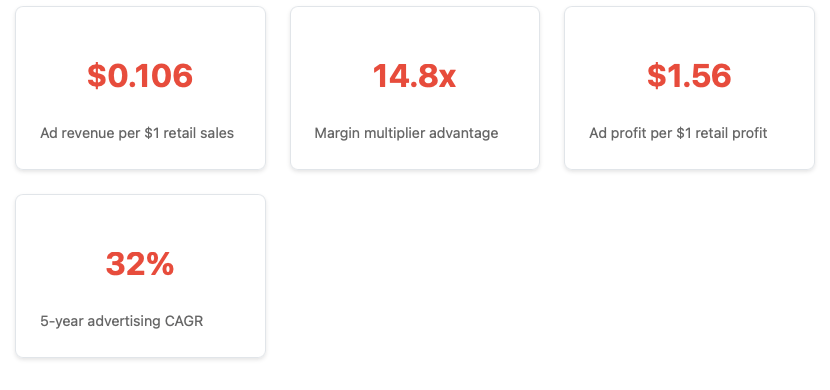
The Bottom Line Up: Retail media can be represented as a compelling arbitrage opportunity in modern commerce, one in which retailers monetize transactional data at 60-80% margins compared to 3-5% retail margins. Amazon exemplifies this transformation, generating $56.2B in advertising revenue from a $637.9B retail foundation—proving that the “side business” can become more profitable than the core operation.

The retail media arbitrage works by converting every purchase, browse, and search into valuable advertising inventory. What makes this particularly powerful is the closed-loop nature: brands can measure exact sales impact, creating premium pricing for advertising that directly drives revenue.

Before turning our attention to Amazon and drilling down into some fine-grained analyses, let us tackle a few basic potential misconceptions:

  • Atoms vs Electrons: in this post I’m kind of looking at retail media from the rearview mirror, as if it made any sense to conceive a physical retail operation to enable a retail media revenue stream – which probably never did, not even when interest rates were below zero; the harsh truth is that atoms-based businesses imply massive fixed costs; success in retail media requires scale and depth; scale implies scalar costs, depth requires expensive technology, even in pure e-commerce. So, no. I’m not advising you to set up a physical or digital retail business only to hope to build a retail media network on top of it. I’d rather suggest to see retail media as…
  • …an incremental profit opportunity for existing retailers: with an interesting twist: is there a way to compensate low or even negative retail profitability through retail media? In other words, would Amazon retail ops make any sense without Amazon Ads margins?

📊 Amazon’s Financial Reality: The Numbers Behind the Arbitrage

🔍 The Profitability Inversion

Amazon’s 2024 financials reveal a stunning transformation:

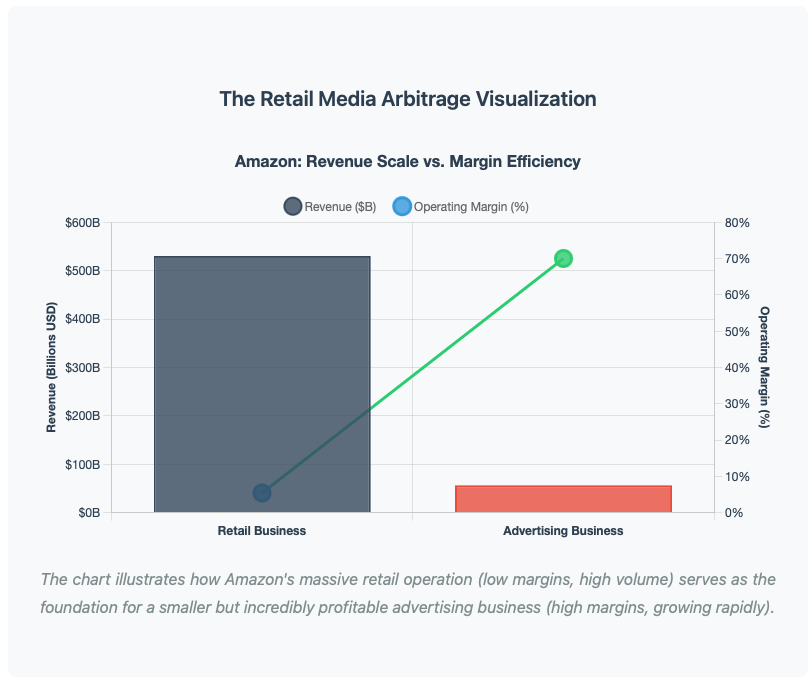
  • Retail Operations: $530.4B revenue generating $28.8B operating profit (5.4% margin)
  • Advertising Operations: $56.2B revenue generating an estimated $33.7B-$45.0B operating profit (60-80% margins)
  • Strategic Implication: The advertising business is now more profitable in absolute terms than the entire retail operation

The Retail Media Arbitrage Visualization

⚡ How the Arbitrage Mechanics Work

🏭 The Data Generation Engine

Every retail transaction creates multiple data points:

  • Transactional Data: Purchase history, frequency, basket composition, seasonal patterns
  • Behavioral Data: Search queries, product views, cart abandonment, review engagement
  • Intent Signals: Category browsing, price sensitivity, brand preferences, timing patterns
  • Customer Journey: Discovery paths, comparison behaviors, loyalty indicators

💰 The Monetization Transformation

This data becomes advertising inventory through three primary channels:

  1. On-site Advertising: Sponsored products, display ads, search promotions within the retailer’s properties
  2. Off-site Extension: Audience targeting across the open web, representing 20%+ of U.S. retail media spend in 2025
  3. Data-as-a-Service: Clean room analytics, measurement insights, and strategic consulting at 80%+ margins

🌍 Market Scale and Growth Trajectory

📈 Global Market Evolution

  • 2025 Projection: $179.5B globally, growing 15.4% year-over-year
  • U.S. Market: ~20% annual growth while overall digital advertising grows single digits
  • European Acceleration: €17-18B in 2025, doubling to €31B by 2028
  • Long-term Target: $100B+ by 2028, representing 19% of total media advertising spend

🏆 Amazon’s Dominant Position

  • Market Leadership: $56.2B in 2024 advertising revenue, 75.2% of U.S. retail media market
  • Duopoly Formation: Amazon + Walmart control 84% of U.S. retail media budgets in 2025
  • Global Expansion: Amazon’s Retail Ad Service extending to external retailers, creating platform business model

🏁 The Strategic Reality: Why This Matters Now

The Fundamental Transformation: Retail media represents more than an additional revenue stream—it’s a complete business model evolution where retailers transform from low-margin commerce operators into high-margin media companies.

The Competitive Imperative: As Amazon demonstrates with $33.7B-$45.0B in estimated advertising operating profit exceeding its $28.8B retail operating profit, the arbitrage opportunity is not just attractive—it’s essential for competitive survival.

The Timeline Reality: While complete retail media sophistication takes 3-5 years to achieve, the technology investments and strategic partnerships required must begin immediately. The retailers who delay implementation will find themselves competing on traditional retail margins while data-enabled competitors capture premium advertising revenues from the same customer base.

The Bottom Line: The combination of third-party cookie deprecation, growing advertiser demand for performance-driven channels, and proven economics of the arbitrage model makes retail media the most compelling opportunity in modern commerce. Success requires viewing retail operations not as the primary business, but as the sophisticated data generation engine that enables a more profitable media business.

Analysis based on Amazon Q4 2024 earnings data, industry research from BCG, McKinsey, eMarketer, and retail media platform providers. All financial data sourced from public earnings reports and verified industry sources.

The Holistic Retail Media Vision – Opportunities, Hurdles, the Long Way Ahead

The length of the journey doesn’t diminish the importance of taking the right steps ahead, now

The Ideal: A Unified Customer Journey Across All Retail Touchpoints

🎯 The Ultimate Goal

Imagine a world where brands can track and understand each customer’s complete journey across every retail interaction—measuring behavior, preferences, and purchase patterns across Amazon, Tesco, Zalando, local pharmacies, and every other touchpoint where products are discovered, considered, and purchased.

This holistic vision represents the holy grail of retail media: a complete, unified view of customer behavior that enables brands to optimize product selection, pricing strategies, and marketing efficiency across the entire retail ecosystem.

The Complete Customer Understanding

In this ideal state, brands would possess:

🔍 Cross-Retailer Journey Mapping

Track individual customers as they research products on Amazon, compare prices at Carrefour, read reviews on specialty retailers, and ultimately purchase through their preferred channel. Understanding not just what they bought, but why they chose that specific retailer for that specific purchase occasion.

📊 Dynamic Price Sensitivity Analysis

Measure how the same customer responds to different price points across retailers, understanding when they prioritize convenience (premium pricing at local stores), value (discount retailers), or experience (premium retailers). This enables sophisticated price elasticity modeling by customer segment and retail channel.

🛍️ Product Selection Optimization

Determine which product variants, pack sizes, and SKUs resonate with specific customer segments across different retail environments. Understanding that the same customer might buy premium organic products at Whole Foods but choose value options at discount retailers based on purchase occasion.

⚡ Real-Time Efficiency Optimization

Dynamically allocate marketing spend based on where each customer is most likely to convert, avoiding wasteful overlap while ensuring comprehensive reach. If a customer typically researches on Amazon but purchases at local stores, marketing investment shifts accordingly.

The Business Impact Vision

With complete cross-retailer customer understanding, brands could achieve:

  • Perfect Retail Media Allocation: Invest marketing dollars exactly where each customer segment is most likely to convert
  • Precision Product Strategy: Launch the right products through the right retailers for the right customer segments
  • Dynamic Pricing Optimization: Adjust pricing strategies based on real customer price sensitivity across channels
  • Elimination of Marketing Waste: End duplicate targeting and optimize for true incremental reach and conversion
  • Customer Lifetime Value Maximization: Understand total customer value across all retail relationships

The Promise: Brands would move from fragmented, retailer-specific campaigns to unified, customer-centric strategies that optimize total business outcomes rather than individual channel performance.

The Reality: Technical and Regulatory Blockers

Despite the compelling vision, multiple fundamental barriers prevent this holistic customer view from becoming reality in today’s market.

Technical Infrastructure Limitations

🏰 Retailer Data Silos

The Core Problem: Each retailer operates as a data fortress, viewing customer information as their primary competitive advantage.

Current Reality: Amazon, Tesco, Zalando, and other retailers maintain completely isolated customer databases with incompatible data formats, measurement methodologies, and attribution models. Cross-retailer data sharing would require these competitors to surrender their most valuable asset.

Technical Requirement: Standardized data formats, unified customer identifiers, and collaborative measurement frameworks—all requiring unprecedented industry cooperation.

🔐 Identity Resolution Complexity

The Challenge: Connecting the same customer across different retailers without shared identifiers.

Current Limitations: Cookie deprecation, device switching, privacy-conscious consumers, and fragmented login behaviors make deterministic matching nearly impossible. Probabilistic matching achieves only 30-50% accuracy and declining.

Technical Requirement: Unified identity solutions requiring customer opt-in, retailer cooperation, and sophisticated privacy-preserving technologies that don’t yet exist at scale.

📱 Platform Fragmentation

The Ecosystem Problem: Each retailer has invested billions in proprietary technology stacks optimized for their business model.

Current State: Amazon’s advertising platform, Criteo’s retail media technology, individual retailer solutions, and emerging platforms all operate with different APIs, measurement standards, and optimization algorithms.

Integration Requirement: Unified APIs, standardized measurement, and interoperable systems requiring massive industry-wide technical harmonization.

Regulatory and Privacy Barriers

⚖️ GDPR and Privacy Legislation

The Legal Reality: European privacy laws explicitly restrict cross-company data sharing without explicit consumer consent.

Current Impact: Sharing customer data between retailers requires individual opt-in consent for each specific use case. Most consumers decline such permissions, and retailers face significant legal risks for non-compliance.

Compliance Requirement: Privacy-preserving technologies that enable insights without exposing individual customer data—technically complex and legally uncertain.

🌍 Global Regulatory Fragmentation

The Complexity: Different privacy laws across markets create compliance nightmares for global brands.

Current Challenge: GDPR in Europe, CCPA in California, emerging regulations in Asia-Pacific, and varying national implementations create incompatible requirements for customer data handling.

Harmonization Need: Global regulatory alignment or sophisticated multi-jurisdiction compliance frameworks.

Business Model Conflicts

💰 Competitive Advantage Protection

The Incentive Problem: Retailers have no business incentive to enable cross-retailer customer understanding.

Strategic Reality: Customer data is how retailers differentiate their advertising offerings and justify premium pricing. Sharing this data would commoditize their retail media platforms and reduce their competitive positioning.

Alignment Challenge: Creating value propositions that incentivize retailer cooperation without undermining their competitive advantages.

The Fundamental Tension: The vision of unified customer understanding directly conflicts with the competitive dynamics that drive retail media growth. Retailers succeed by offering exclusive access to their customer insights—the very exclusivity that prevents holistic measurement.

The Evolution Path: Practical Steps Toward the Vision

While the complete holistic vision remains distant, brands can take evolutionary steps that move closer to unified customer understanding within current technical and regulatory constraints.

Phase 1: Enhanced Segmentation and Specialization (0-12 Months)

🎯 Retailer-Specific Customer Profiling

Approach: Deep-dive into each retailer’s endemic customer base to understand their unique characteristics, shopping behaviors, and preferences.

  • Analyze first-party data provided by each retailer to identify customer segments that naturally gravitate toward specific retail environments
  • Map product categories, price points, and shopping occasions that align with each retailer’s customer base
  • Develop retailer-specific personas that guide product selection and marketing strategy

Immediate Value: Reduce overlap through strategic specialization rather than technical deduplication.

📊 Advanced Attribution Modeling

Approach: Implement sophisticated statistical models that infer cross-retailer influence without direct customer matching.

  • Use geographic, demographic, and temporal correlations to estimate customer overlap
  • Implement holdout testing across retailers to measure incremental impact
  • Develop category-level attribution models that account for cross-retailer influence

Immediate Value: Better understanding of true incrementality and marketing efficiency.

Phase 2: Privacy-Safe Collaboration (12-24 Months)

🔐 Clean Room Partnerships

Approach: Leverage emerging privacy-safe technologies for limited cross-retailer insights.

  • Participate in retailer clean room initiatives (Amazon Marketing Cloud, Google Ads Data Hub) where available
  • Develop aggregate-level insights about customer journey patterns without individual identification
  • Test unified ID solutions with cooperative retailers in limited pilot programs

Evolution Value: First steps toward technical infrastructure for cross-retailer measurement.

🤝 Strategic Retailer Partnerships

Approach: Negotiate enhanced data sharing agreements with key retail partners.

  • Request anonymized, aggregate customer journey data as part of strategic partnership agreements
  • Pilot cross-retailer measurement programs with non-competing retailers
  • Develop shared value propositions that incentivize retailer cooperation

Evolution Value: Build foundation for more sophisticated collaboration as technology matures.

Phase 3: Advanced Integration (24-36 Months)

🧠 AI-Powered Journey Prediction

Approach: Use machine learning to predict customer behavior across retailers without direct tracking.

  • Develop predictive models based on purchase patterns, seasonal behaviors, and demographic correlations
  • Implement dynamic budget allocation algorithms that optimize across retailer portfolio
  • Test federated learning approaches where available

Future Value: Approach holistic optimization through prediction rather than direct measurement.

🔄 Platform Standardization Advocacy

Approach: Actively participate in industry initiatives driving measurement standardization.

  • Support IAB Europe retail media measurement standards development
  • Participate in industry working groups focused on cross-platform measurement
  • Advocate for standardized APIs and data formats across retail media platforms

Industry Value: Contribute to ecosystem development that benefits all participants.

🗓️ Realistic Timeline Expectations

Years 1-2: Enhanced retailer specialization and improved attribution modeling

Years 3-5: Limited cross-retailer insights through privacy-safe technologies

Years 5-10: Meaningful cross-retailer journey understanding with regulatory evolution

10+ Years: Possible approach to holistic customer view with industry transformation

What Brands Should Demand from Retailers

To advance toward the holistic vision, brands must strategically negotiate for specific capabilities and data access that lay the groundwork for future customer understanding.

Immediate Requests (Available Today)

📈 Enhanced Attribution Data

  • Customer Journey Insights: Anonymized data showing how customers discovered, researched, and purchased products within the retailer ecosystem
  • Cross-Channel Attribution: Understanding how retail media influences in-store purchases and vice versa
  • Competitive Context: Performance benchmarking against category averages and key competitors

🎯 Audience Segmentation Detail

  • Customer Personas: Detailed profiles of customer segments that shop specific categories or price points
  • Shopping Behavior Analysis: Understanding of when, why, and how different customer segments engage with the retailer
  • Lifecycle Stage Mapping: Insights into customer acquisition, retention, and churn patterns

Medium-Term Negotiations (12-24 Months)

🔐 Privacy-Safe Collaboration

  • Clean Room Access: Participation in retailer privacy-safe analytics platforms for cross-campaign insights
  • Aggregate Journey Data: Statistical insights about customer movement between online and offline, different categories, and purchase occasions
  • Cohort Analysis: Understanding customer behavior changes over time without individual identification

📊 Standardized Measurement

  • IAB Compliance: Adoption of industry-standard measurement frameworks for comparable cross-retailer analysis
  • API Standardization: Consistent data formats and reporting structures across different retail media platforms
  • Third-Party Verification: Independent measurement verification for attribution and incrementality claims

Long-Term Strategic Partnerships (24+ Months)

🤝 Cross-Retailer Pilot Programs

  • Non-Competing Collaboration: Joint measurement initiatives with retailers in different categories or geographies
  • Unified ID Testing: Participation in industry initiatives for privacy-compliant customer identification
  • Federated Learning Pilots: Experimental programs for cross-retailer insights without data sharing

Negotiation Strategy Framework

🎯 Value Exchange Approach

Position data requests as mutual value creation rather than one-sided demands:

  • Category Growth: Enhanced customer understanding drives category expansion benefiting retailer revenue
  • Innovation Partnership: Better insights enable more relevant product development and launches
  • Marketing Efficiency: Reduced waste and improved targeting benefits retailer customer experience
  • Competitive Advantage: Advanced analytics capabilities differentiate progressive retailers

📋 Phased Implementation

Structure requests as progressive partnership evolution:

  • Proof of Value: Start with limited data sharing to demonstrate mutual benefits
  • Success Metrics: Establish clear KPIs for partnership value and data utility
  • Expansion Path: Create roadmap for enhanced collaboration based on initial success
  • Industry Leadership: Position early adopters as retail media innovation leaders

Conclusion: The Path Forward

The vision of unified customer understanding across all retail touchpoints remains compelling but distant. Current technical limitations, regulatory constraints, and competitive dynamics prevent true cross-retailer customer tracking and optimization.

The Strategic Reality

Brands must accept that perfect efficiency through complete customer deduplication is not achievable today. Instead, the focus should shift to:

  • Strategic Specialization: Optimize each retailer relationship for their endemic customer strengths
  • Sophisticated Attribution: Develop statistical models that approximate cross-retailer influence
  • Progressive Partnership: Negotiate incremental data access that builds toward future capabilities
  • Industry Advocacy: Support standardization initiatives that benefit the entire ecosystem

The Long-Term Opportunity

While complete customer unification may take a decade or more, brands that begin building the foundation today—through enhanced retailer partnerships, privacy-safe collaboration, and advanced analytics—will be positioned to capitalize as enabling technologies mature.

The Bottom Line: The holistic retail media vision is worth pursuing not because it’s achievable today, but because the journey toward it drives more sophisticated customer understanding, better retailer partnerships, and improved marketing efficiency. Progress, not perfection, should be the goal.

Beyond Sell-In: CPG Retail Media Governance Framework

How to allocate roles and responsibilities for retail media management to optimize sales, customer insights, category understanding, and minimize cross-channel conflicts

🎯 The Strategic Question

How can a CPG brand allocate roles and responsibilities for retail media management to obtain the best outcomes in terms of sales performance, customer understanding, category insights, and market intelligence, while minimizing cross-channel conflicts?

The Governance Decision Framework

Retail media budget ownership should be the outcome of a structured decision-making process that evaluates organizational capabilities, strategic priorities, and operational requirements. The choice between marketing-led, trade-led, or hybrid governance models significantly impacts performance across four critical dimensions:

📈 Sales Performance

Revenue optimization, incrementality measurement, and cross-channel sales attribution

👥 Customer Understanding

Consumer insights, journey mapping, and behavioral analytics

🏪 Category Intelligence

Market dynamics, competitive positioning, and retailer relationship optimization

🔄 Cross-Channel Harmony

Message consistency, budget efficiency, and conflict minimization

Governance Model Comparison

Governance ModelSales PerformanceCustomer InsightsCategory IntelligenceCross-Channel Harmony
Marketing-LedExcellent
Advanced attribution, cross-channel optimization
Superior
Integrated consumer journey, sophisticated segmentation
Limited
Surface-level category understanding
Excellent
Unified message strategy, budget efficiency
Trade-LedGood
Retailer-specific optimization, limited cross-channel view
Moderate
Transactional insights, limited consumer understanding
Excellent
Deep retailer dynamics, competitive intelligence
Poor
Siloed execution, potential conflicts
Hybrid ModelVery Good
Balanced optimization, integrated measurement
Good
Combined insights, comprehensive view
Very Good
Strategic + operational intelligence
Good
Coordinated execution, managed conflicts

Marketing-Led Governance

🎯 Optimal Conditions

  • Multiple retail media networks requiring sophisticated optimization
  • Strong marketing technology infrastructure and analytics capabilities
  • Cross-channel campaign integration priorities
  • Innovation-focused retail media strategy

Sales Performance Advantages

  • Advanced Attribution: Cross-channel measurement enabling true incrementality assessment
  • Budget Optimization: Real-time allocation based on performance data rather than relationship dynamics
  • Scale Efficiency: Unified campaigns across multiple retailers with consistent optimization

Customer Understanding Benefits

  • Journey Integration: Retail media insights integrated with broader customer journey mapping
  • Audience Sophistication: Advanced segmentation and personalization capabilities
  • Behavioral Analytics: Consumer behavior analysis across all touchpoints

Key Limitation: Marketing teams often lack deep understanding of retailer-specific category dynamics and competitive intelligence that trade teams possess.

Trade-Led Governance

🎯 Optimal Conditions

  • Concentrated retail landscape with few dominant partners
  • Category-focused retail media strategy
  • Strong existing trade team relationships and expertise
  • Limited marketing technology resources

Category Intelligence Advantages

  • Retailer Dynamics: Deep understanding of individual retailer business models and priorities
  • Competitive Intelligence: Real-time insights into competitor activities and market dynamics
  • Category Context: Retail media optimization within broader category management strategy

Relationship Benefits

  • Strategic Integration: Retail media aligned with trade negotiations and partnership development
  • Operational Efficiency: Streamlined execution through existing retailer communication channels
  • Partnership Leverage: Retail media investment strengthening overall trade relationships

Key Limitation: Trade teams typically lack sophisticated marketing technology capabilities and cross-channel consumer understanding.

Hybrid Governance Model

🔄 Collaborative Framework

The hybrid model combines marketing strategy and technology capabilities with trade relationship management and category expertise.

Marketing Responsibilities

  • Strategy development and performance standards
  • Cross-channel integration and measurement
  • Technology platform management
  • Consumer insights and journey optimization

Trade Responsibilities

  • Retailer relationship management
  • Category intelligence and competitive analysis
  • Day-to-day campaign execution
  • Trade negotiation integration

Shared Governance Structure

  • Joint Planning: Collaborative retail media strategy development
  • Integrated Measurement: Combined marketing attribution with trade intelligence
  • Cross-Functional Teams: Marketing and trade representatives on retail media steering committees
  • Escalation Protocols: Clear decision-making hierarchy for budget allocation and strategy conflicts

Cross-Channel Conflict Minimization

Common Conflict Sources

  • Message Inconsistency: Different creative approaches across retail media and other channels
  • Audience Overlap: Competing campaigns targeting the same consumers
  • Attribution Disputes: Multiple channels claiming credit for the same conversions
  • Budget Competition: Retail media competing with other marketing investments

Conflict Resolution Strategies

Unified Creative Strategy

  • Consistent brand messaging across all touchpoints
  • Retailer-specific creative adaptation guidelines
  • Cross-channel creative approval processes

Integrated Attribution

  • Statistical attribution models accounting for all channels
  • Holdout testing to measure true incrementality
  • Unified customer journey measurement

Coordinated Planning

  • Joint campaign calendars and timing coordination
  • Audience segmentation to minimize overlap
  • Budget allocation based on total business impact

Performance Optimization

  • Cross-channel budget reallocation based on performance
  • Integrated optimization algorithms
  • Unified customer lifetime value measurement

Decision Framework

🎯 Strategic Recommendations

Choose Marketing-Led When:

  • Operating across 5+ retail media networks
  • Strong marketing technology and analytics capabilities
  • Cross-channel integration is strategic priority
  • Innovation and testing focus

Choose Trade-Led When:

  • Concentrated retail landscape (2-3 dominant partners)
  • Category-focused strategy with deep retailer relationships
  • Limited marketing technology resources
  • Trade relationship leverage is critical

Choose Hybrid When:

  • Balanced portfolio of retail partners
  • Both marketing sophistication and trade relationships are strong
  • Complex category dynamics requiring integrated approach
  • Sufficient resources to manage collaborative governance

Implementation Roadmap

Phase 1: Assessment (Months 1-2)

  • Evaluate current organizational capabilities and gaps
  • Assess retail media performance under current governance
  • Analyze cross-channel conflicts and inefficiencies
  • Define success metrics for governance optimization

Phase 2: Design (Months 3-4)

  • Select optimal governance model based on assessment
  • Design roles, responsibilities, and decision-making processes
  • Develop integrated measurement and attribution frameworks
  • Create conflict resolution and escalation protocols

Phase 3: Implementation (Months 5-8)

  • Transition to new governance structure
  • Implement integrated technology and measurement systems
  • Train teams on new processes and responsibilities
  • Establish regular performance review cycles

Phase 4: Optimization (Months 9-12)

  • Monitor performance against success metrics
  • Refine processes based on learnings and feedback
  • Expand successful practices across all retail partnerships
  • Plan for future governance evolution

Key Success Factors

Critical Insight: The most successful retail media governance models are those that combine the strategic sophistication of marketing teams with the relationship depth and category expertise of trade teams, while maintaining clear accountability and minimizing operational complexity.

Essential Requirements

  • Clear Accountability: Unambiguous ownership and decision-making authority
  • Integrated Measurement: Unified attribution and performance tracking
  • Cross-Functional Collaboration: Structured communication and planning processes
  • Technology Integration: Platforms enabling collaboration and optimization
  • Continuous Evolution: Regular governance review and optimization

📊 Bottom Line

Optimal retail media governance requires matching organizational structure to strategic priorities and operational capabilities. The goal is maximizing performance across sales, customer understanding, category intelligence, and cross-channel harmony while minimizing complexity and conflicts. Success depends on clear accountability, integrated measurement, and continuous optimization rather than rigid adherence to any single governance model.

Podcast SEO and content discovery

An ever-growing medium, still very open to innovation both in discovery and monetisation.

Until recently podcasts were not seen as direct SEO assets.

Manish Dudharejia

For a few years now, I’ve added podcasts as a time filler for commute, housekeeping, car trips – the other being music. The enormous quantity of content that has transited across my ears is, with few exceptions, packed in a sequential format: in order to get to the last word you have to stream (or skip) all those that came before.

Through this endless flow of commentary, information, I’ve learned a lot. However I find it very hard, for the very sequential nature of the medium, to go seek for interesting bits of information that I have discovered previously.

While podcast apps such as Overcast help indexing topics covered during the podcast – by giving podcasters the option to push the index along with the audio file – there’s no easy way to look back for specific bits of content.

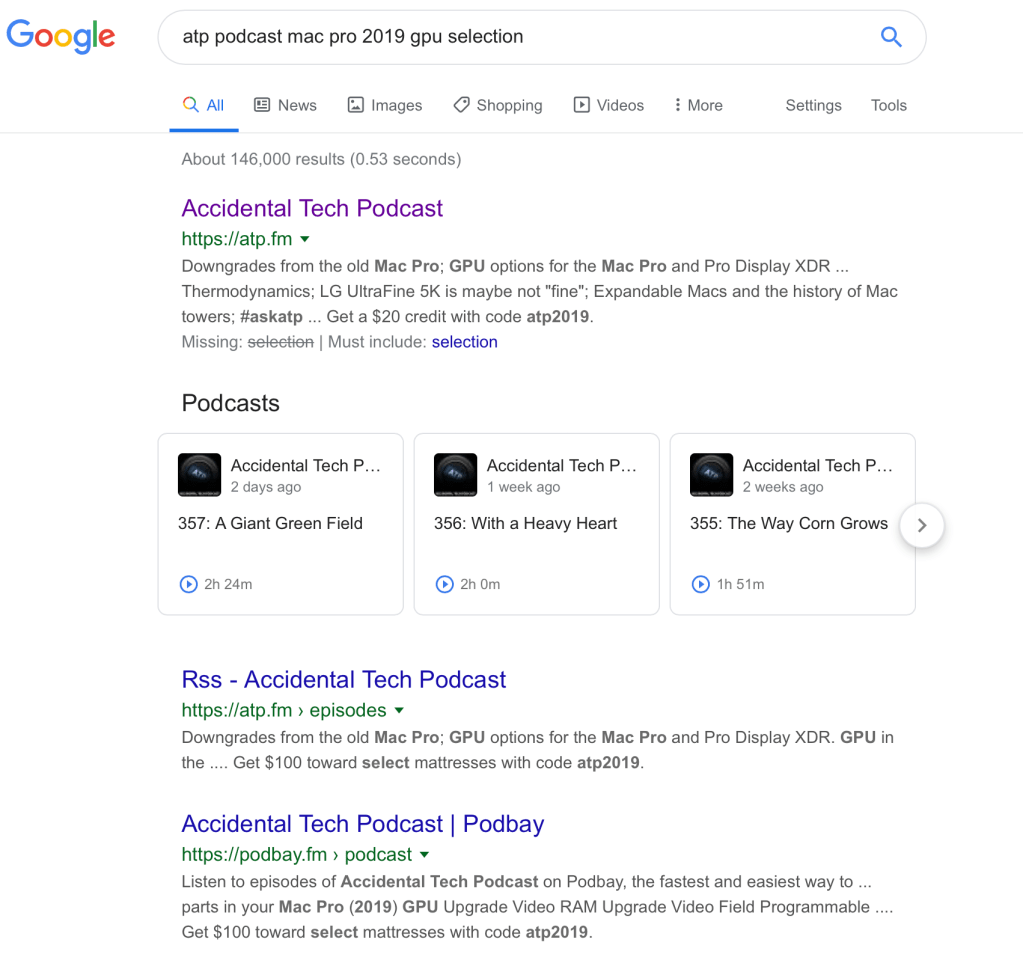
As this post explains, Google is giving more and more attention to the podcast indexing puzzle. Speech to text technology available in Google Cloud can be instrumental in the indexing process, however podcast search results reliability is still very lacking.

In order to reach the great insights by John, Marco and Casey about the searched topic, I had to specify the name of the podcast in the search and even then, no text snippets are available in the SERP. When clicking in the “Podcasts” widget I was able to retrieve the abstract of the relevant podcast, but then again, the podcast widget only appeared when I added atp podcast to the topic, in the search.

Also, the guys at ATP.fm do a great job in indexing their podcast, and publishing this index in a site, which in turn affects its visibility in the aforementioned SERP for specific content. Many good podcasts I listen to don’t provide any sort of index nor do they have a detailed episode description, and I suspect this will make them invisible in Google too.

In fact I believe the podcast widget in the SERP and the podcasts inside it, were only there because of their index – and because I added the word podcast and the specific podcast I was looking for in the search box.

So there’s still much to do in content discovery with podcasts

And Google for now isn’t helping much, although things could move very quickly in 2020. The state of in-app content discovery is a topic I would like to explore soon. My podcast app of choice, Overcast, is doing a good job but it’s still mainly focused on sequential fruition. Who knows! Maybe 2020 will bring a content discovery oriented podcast app – one specifically addressed to solve time-filling and finding commentary on specific topics cross-podcasts!

As of today, there’s much to do to improve the state of content discovery in the very fragmented and chaotic podcast market. Mind you, I like this fragmentation, it very much resembles the heyday of the www, when content discovery was very much lacking, and wandering around the web was a joy in its own right. But since more order will inevitably come, I think it’s worth exploring what’s ahead.

So stay tuned for more content on this topic: in the next days I will keep drilling on the content discovery side, and how it can affect (maybe improve?) monetisation.

Who’s me

A tech wanderer, not (yet) lost

Back when a Commodore Vic-20 was sitting on my desk, and I was staring at a TV screen prompting endless ?SYNTAX ERROR, I saw technology as an impenetrable, yet interesting world. Many decades later, I still somehow see it the same way. I’ve wandered through many of its faces, yet more and more seem to happen at each step.

After much tinkering, learning, and making mistakes, I can’t say I mastered any topic. Rather, I started enjoying the wandering.

I hope what you read here will interest you and open a way for something even more interesting, outside here.