
Thanks to its massive scale and advanced technology, Amazon has successfully used its retail business to pivot to a data business, which today represents its main source of profits. Can this pivot also work at a smaller scale? Does it make any sense to execute retail only to create transactional data?
🎯 The Ultimate Arbitrage: Turning Retail Data into Advertising Gold
The Bottom Line Up: Retail media can be represented as a compelling arbitrage opportunity in modern commerce, one in which retailers monetize transactional data at 60-80% margins compared to 3-5% retail margins. Amazon exemplifies this transformation, generating $56.2B in advertising revenue from a $637.9B retail foundation—proving that the “side business” can become more profitable than the core operation.
The retail media arbitrage works by converting every purchase, browse, and search into valuable advertising inventory. What makes this particularly powerful is the closed-loop nature: brands can measure exact sales impact, creating premium pricing for advertising that directly drives revenue.
Before turning our attention to Amazon and drilling down into some fine-grained analyses, let us tackle a few basic potential misconceptions:
- Atoms vs Electrons: in this post I’m kind of looking at retail media from the rearview mirror, as if it made any sense to conceive a physical retail operation to enable a retail media revenue stream – which probably never did, not even when interest rates were below zero; the harsh truth is that atoms-based businesses imply massive fixed costs; success in retail media requires scale and depth; scale implies scalar costs, depth requires expensive technology, even in pure e-commerce. So, no. I’m not advising you to set up a physical or digital retail business only to hope to build a retail media network on top of it. I’d rather suggest to see retail media as…
- …an incremental profit opportunity for existing retailers: with an interesting twist: is there a way to compensate low or even negative retail profitability through retail media? In other words, would Amazon retail ops make any sense without Amazon Ads margins?
📊 Amazon’s Financial Reality: The Numbers Behind the Arbitrage
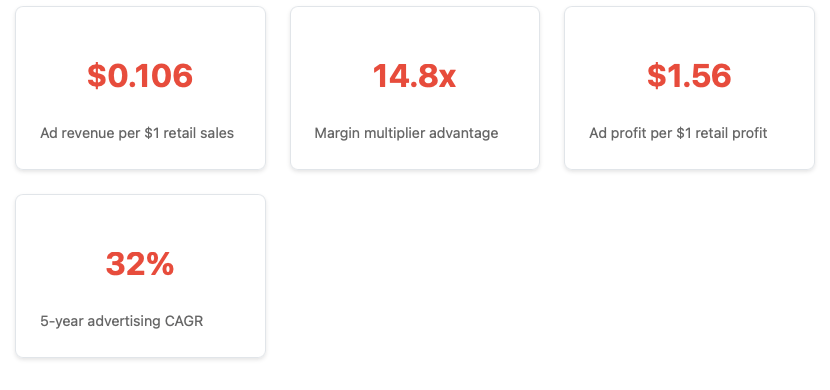
🔍 The Profitability Inversion
Amazon’s 2024 financials reveal a stunning transformation:
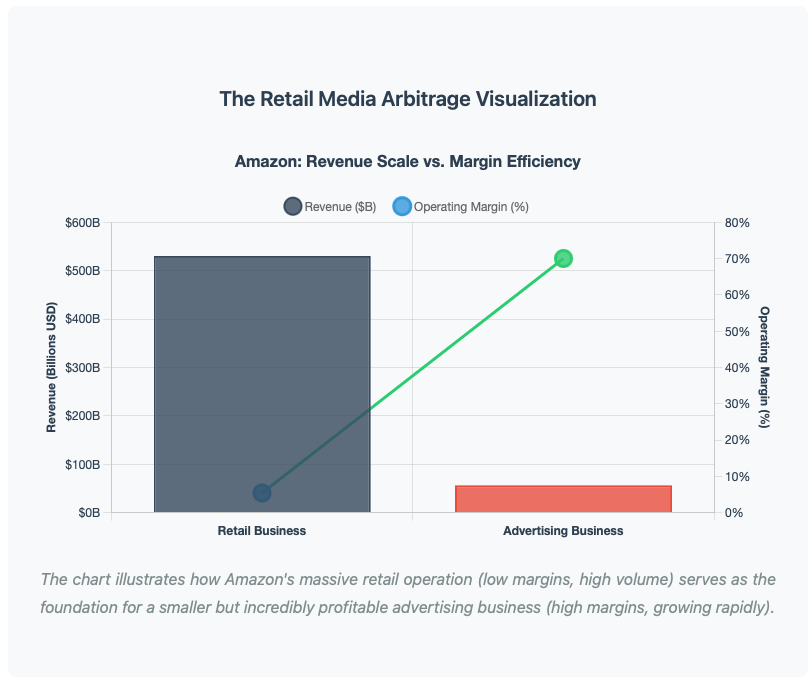
- Retail Operations: $530.4B revenue generating $28.8B operating profit (5.4% margin)
- Advertising Operations: $56.2B revenue generating an estimated $33.7B-$45.0B operating profit (60-80% margins)
- Strategic Implication: The advertising business is now more profitable in absolute terms than the entire retail operation
The Retail Media Arbitrage Visualization
⚡ How the Arbitrage Mechanics Work
🏭 The Data Generation Engine
Every retail transaction creates multiple data points:
- Transactional Data: Purchase history, frequency, basket composition, seasonal patterns
- Behavioral Data: Search queries, product views, cart abandonment, review engagement
- Intent Signals: Category browsing, price sensitivity, brand preferences, timing patterns
- Customer Journey: Discovery paths, comparison behaviors, loyalty indicators
💰 The Monetization Transformation
This data becomes advertising inventory through three primary channels:
- On-site Advertising: Sponsored products, display ads, search promotions within the retailer’s properties
- Off-site Extension: Audience targeting across the open web, representing 20%+ of U.S. retail media spend in 2025
- Data-as-a-Service: Clean room analytics, measurement insights, and strategic consulting at 80%+ margins
🌍 Market Scale and Growth Trajectory
📈 Global Market Evolution
- 2025 Projection: $179.5B globally, growing 15.4% year-over-year
- U.S. Market: ~20% annual growth while overall digital advertising grows single digits
- European Acceleration: €17-18B in 2025, doubling to €31B by 2028
- Long-term Target: $100B+ by 2028, representing 19% of total media advertising spend
🏆 Amazon’s Dominant Position
- Market Leadership: $56.2B in 2024 advertising revenue, 75.2% of U.S. retail media market
- Duopoly Formation: Amazon + Walmart control 84% of U.S. retail media budgets in 2025
- Global Expansion: Amazon’s Retail Ad Service extending to external retailers, creating platform business model
🏁 The Strategic Reality: Why This Matters Now
The Fundamental Transformation: Retail media represents more than an additional revenue stream—it’s a complete business model evolution where retailers transform from low-margin commerce operators into high-margin media companies.
The Competitive Imperative: As Amazon demonstrates with $33.7B-$45.0B in estimated advertising operating profit exceeding its $28.8B retail operating profit, the arbitrage opportunity is not just attractive—it’s essential for competitive survival.
The Timeline Reality: While complete retail media sophistication takes 3-5 years to achieve, the technology investments and strategic partnerships required must begin immediately. The retailers who delay implementation will find themselves competing on traditional retail margins while data-enabled competitors capture premium advertising revenues from the same customer base.
The Bottom Line: The combination of third-party cookie deprecation, growing advertiser demand for performance-driven channels, and proven economics of the arbitrage model makes retail media the most compelling opportunity in modern commerce. Success requires viewing retail operations not as the primary business, but as the sophisticated data generation engine that enables a more profitable media business.
Analysis based on Amazon Q4 2024 earnings data, industry research from BCG, McKinsey, eMarketer, and retail media platform providers. All financial data sourced from public earnings reports and verified industry sources.

